Match analysis · 7 min
Connecting match analysis and scouting: from game signal to transfer profile
How match scenes, event data and role requirements become a reliable transfer profile.
FI-SO 360° Redaktion ·
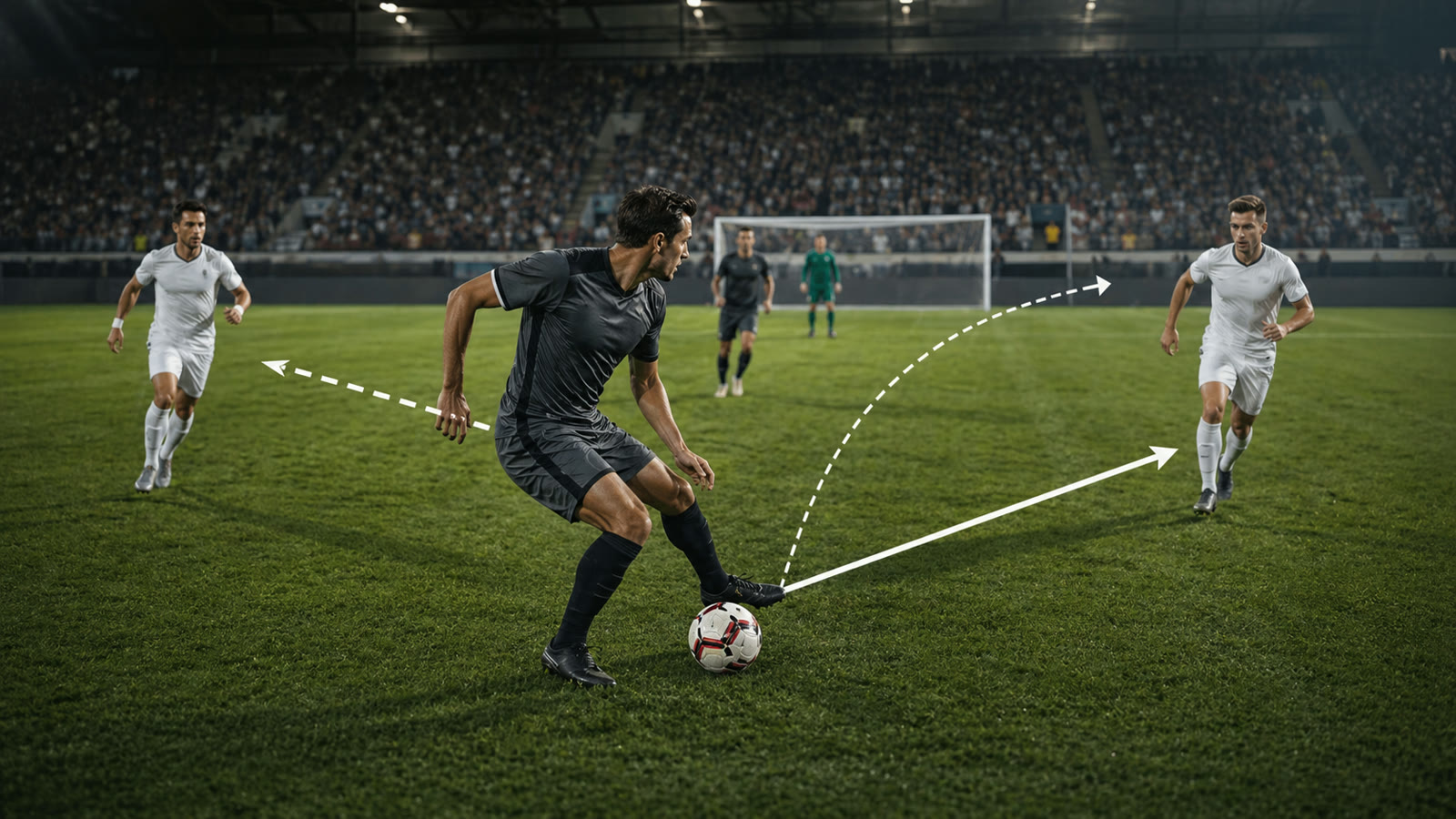
The best metric still needs a scene
The best metric needs a scene.
Otherwise it remains a claim.
An event says what happened.
The scene says why it happened.
Scouting rarely fails because there are too few numbers.
It fails because numbers have no meaning.
An action becomes valuable only when it is translated into a role.
Not: nice pass.
But: does this player solve the exact pressure our team creates or suffers?
That is the move from match signal to transfer profile.
From event to context
The uncomfortable truth: highlights sell hope.
Profiles test repeatability.
Event data is a useful entry point because it makes actions comparable.
Passes, dribbles, duels, pressing actions and shots can be aggregated across many games.
But an event is never the full context.
For a transfer profile, analysts should ask:
- What happened before the action?
- Was the player under opponent pressure?
- Which follow-up options appeared?
- Was the action role-relevant or just visually striking?
- Does the pattern repeat against different opponents?
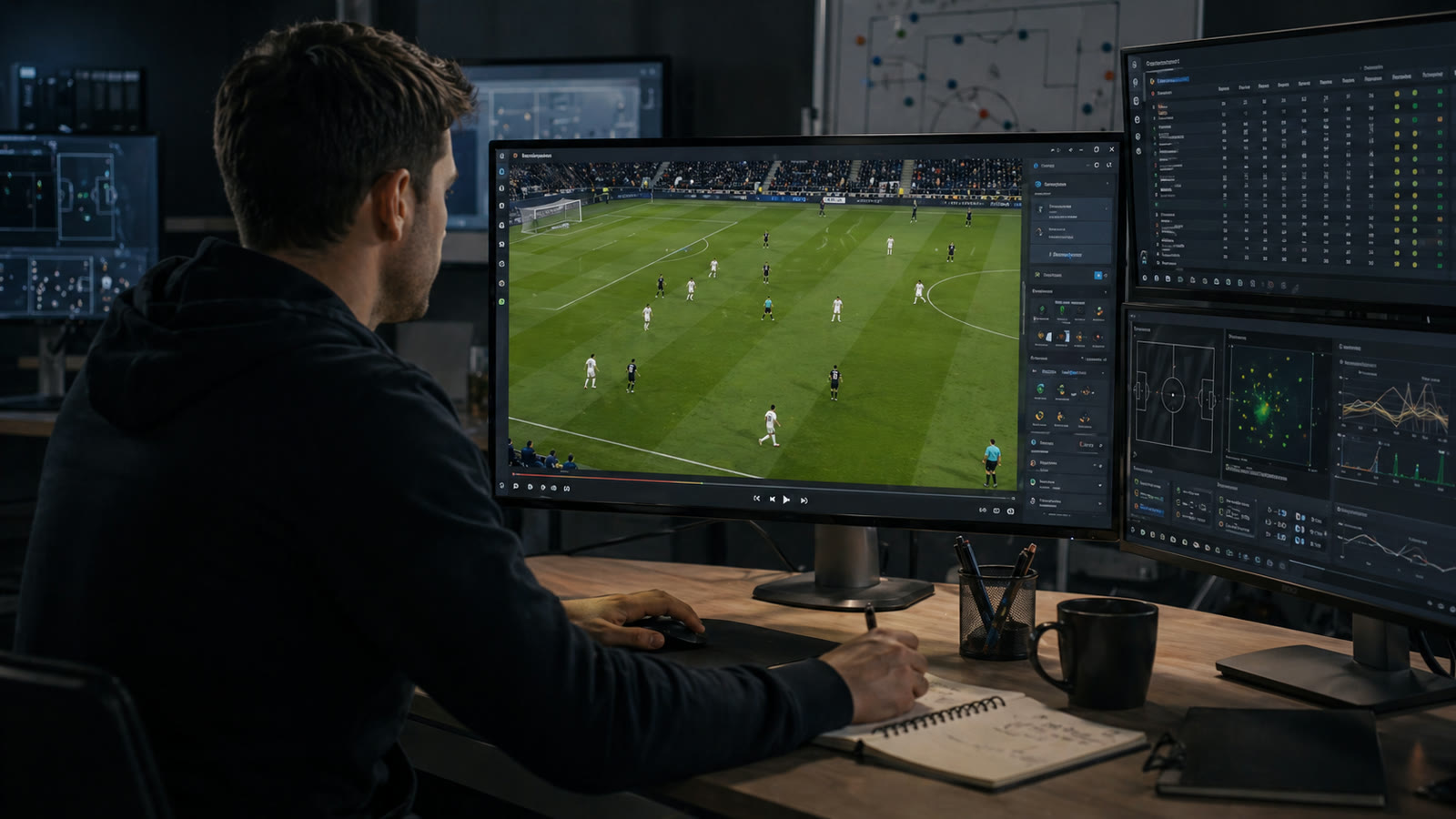
These questions connect data with video.
Role requirements as the bridge
The key lever is the role profile.
It decides which match scenes are truly relevant.
For a build-up centre-back, pressure solutions, passing angles and calmness in the first third matter more than raw clearances.
For a box defender, timing, body shape and penalty-area behaviour are more important.
Match analysis therefore becomes more focused.
It is not looking for attractive clips, but for evidence of a concrete role.
Transfer profiles need repeatability
One strong scene is not enough.
A transfer profile becomes reliable when patterns repeat:
- across several games
- against different opponents
- in similar game situations
- under comparable role tasks
This is where data helps.
It shows where video work should start.
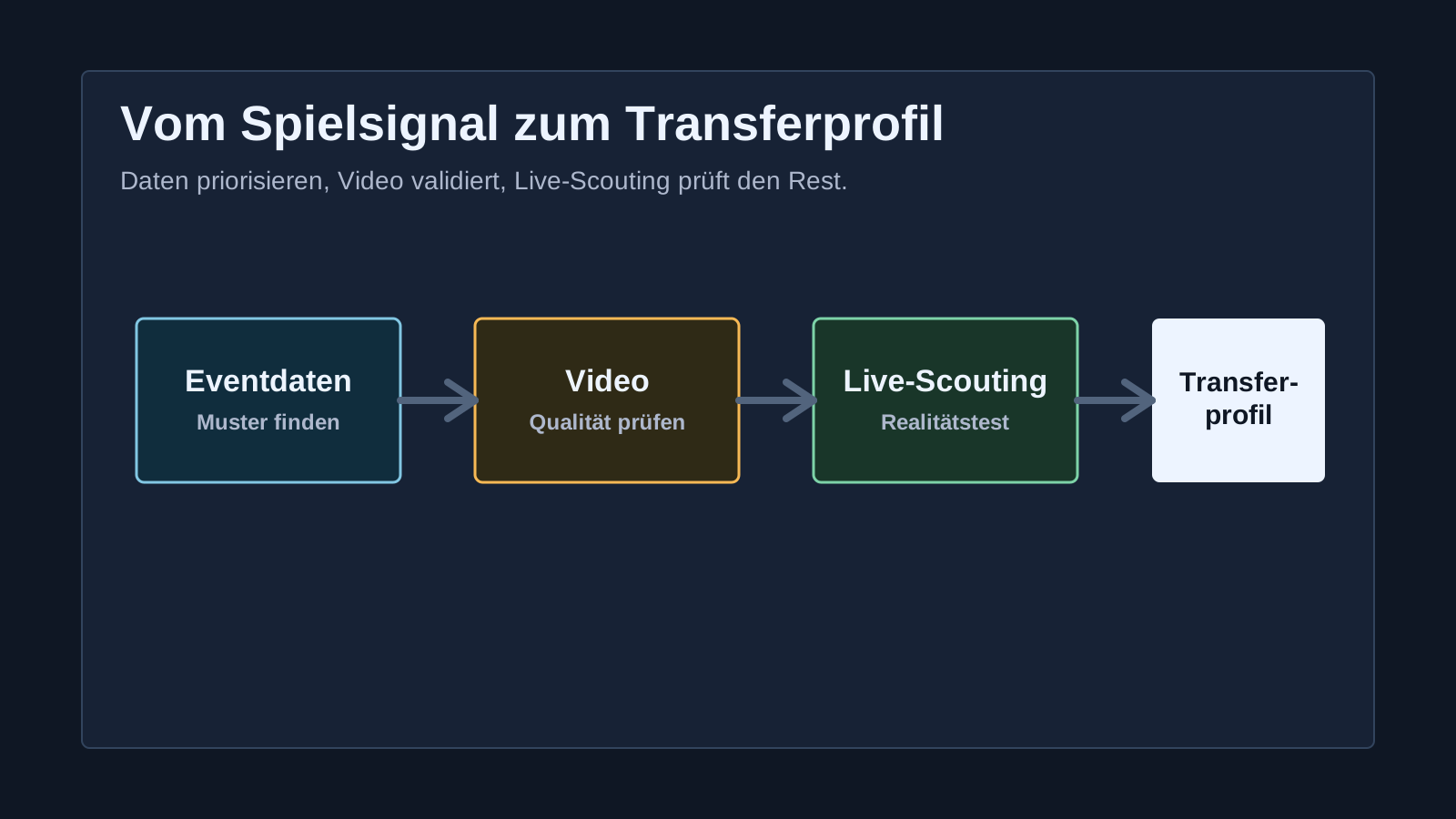
Video then shows whether the data is a real skill signal or only a context artefact.
Conclusion
Match analysis and scouting should not run separately.
Data prioritises, video validates and role profiles organise the evidence.
That connection creates a transfer profile that does not only say what a player did, but why it could matter for the next club.

Why transfer profiles need more than highlight clips
Highlight clips are tempting.
They show a player’s best actions, compress emotion and make quality visible quickly.
For transfer decisions, they are not enough.
A transfer profile must show not only what a player can do, but how repeatable that quality is and under which conditions it appears.
Match analysis is the path from attractive scene to reliable evidence.
It does not only ask: was the action good?
It asks: why was it good?
Was it relevant for the target role?
Was the opponent pressure real?
Were there better options?
Did the action appear because of a team structure the new club can also provide?
These questions matter because transfers often fail through context.
A player who is perfectly embedded in his current team may look less effective in a new team if the supporting movements, distances or cover structures are missing.
Match analysis makes those dependencies visible.
Event data shows where video work begins
Event data is an excellent starting point.
It can show which players perform certain actions often, which zones they use and whether values remain stable across several games.
For analysts, that saves a lot of time.
But event data should not be the end of the check.
It is a signpost.
If a centre-back plays many progressive passes, video work begins there: which passing angles does he use?
How often does he play under pressure?
Are the receivers free because the team structure is strong, or does he create solutions himself?
How often does he truly break lines instead of playing safe balls into open space?
A statistic becomes an investigation path.
The number says where to look.
The video says what is really happening.
Sort scenes by role requirements
Strong match analysis does not sort scenes only chronologically.
It sorts them by role requirements.
For a winger, this could mean one-v-one actions, runs in behind, counter-pressing and box occupation.
For a number six: availability, pressure solutions, space control and rest defence.
For a centre-back: box protection, open-space defending, build-up angles and duel behaviour.
This sorting prevents the analysis from becoming a clip collection.
Every clip answers a question from the role profile.
That is valuable for sporting directors and coaches because they do not only see isolated actions.
They see a pattern.
A simple separation is especially useful: positive evidence, negative evidence and open questions.
Positive evidence shows that a requirement is met.
Negative evidence shows a risk.
Open questions mark what has not yet been checked sufficiently.
From single game to pattern
One game can deceive.
Opponent plan, scoreline, pitch conditions, teammates and daily form all influence evaluation.
A transfer profile should therefore combine several matches.
Not every match needs a full analysis, but the key role questions should be checked in different contexts.
Strong patterns appear through repetition.
A player does not solve pressure cleanly only once, but again and again.
He does not defend open spaces only against weak opponents, but also against pace.
He does not find diagonal passes only when he has time, but also from harder body positions.
If a pattern only works in a specific context, that is also useful.
The club then knows under which conditions the player is strong and which environment he may need in the new team.
Data and video as a dialogue
The best analysis process is not either-or.
Data and video speak to each other.
Data can create a hypothesis, video tests it.
Video can reveal a quality, data checks its frequency.
A scout can bring an observation that is then searched for in the dataset.
This dialogue protects against two extremes.
The first is data-blind instinct: a player looks strong in three scenes, but the pattern does not hold.
The second is video-free number worship: a value looks strong, but the actions do not fit the target role.
Reliable transfer evaluation sits between both.
What a good transfer profile should include
A good transfer profile does not need to be endless.
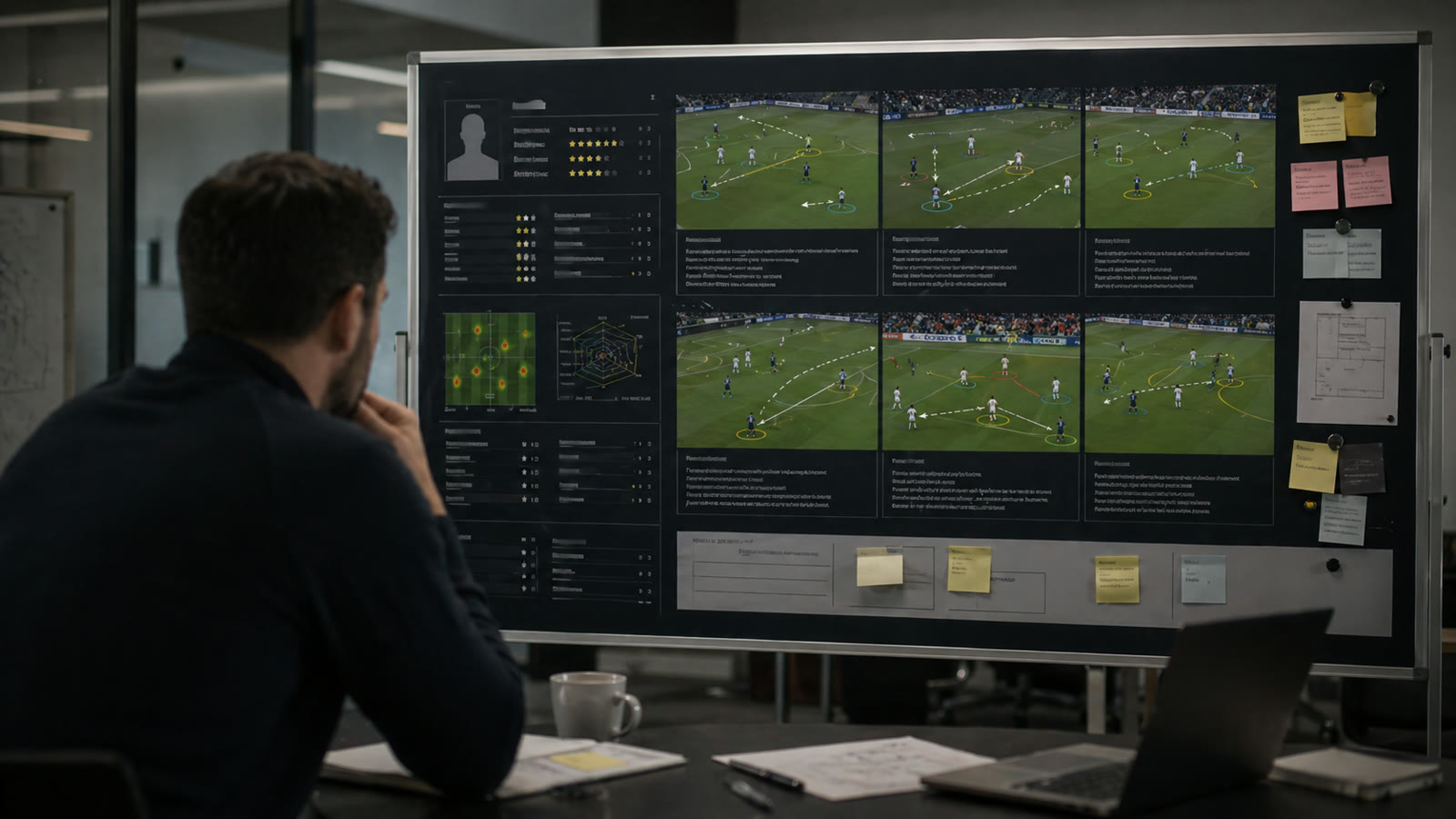
But it should include the decisive layers:
- target role and game-model connection
- key data indicators
- meaningful match scenes
- repeatability of patterns
- context around current team role
- risks and counterarguments
- concrete next recommendation
This structure makes the report usable.
The coach sees whether the player fits the team’s behaviours.
The sporting director sees which risks must be clarified before an offer.
The scout sees which questions should be watched in the next live match.

Conclusion
Match analysis is not only proof for data.
It is the place where data receives meaning.
Clubs that connect event data, role profiles and video scenes build transfer profiles that go beyond highlight clips.
The resulting evaluation does not only say: this player had good actions.
It says: these actions are relevant for our role, they repeat in certain contexts, and these open questions must be clarified before a decision.
That is why match analysis is so valuable in the transfer process.
Live scouting remains the reality test
Even the best video and data analysis cannot replace every stadium impression.
Live scouting shows things that are hard to capture in event data: communication, body language after mistakes, orientation away from the ball, reaction to coaching, intensity in long phases without direct action.
These observations matter especially in higher-risk transfers.
The value is not in setting data against the eye.
Live scouting should be prepared by data and video analysis.
If the transfer profile marks open questions, the live scout can watch for them deliberately.
How does the centre-back defend when his team is disorganised?
How often does the number six scan before the first touch?
How does the winger react after losing the ball?
Transfer profiles should prepare decisions, not only describe
A common mistake is writing profiles like player portraits.
They sound good, but they do not prepare a decision.
A transfer profile must make clear what should happen next.
Keep monitoring?
Go deeper on video?
Check medical history?
Start market conversations?
Remove from the list?
That action recommendation makes the report valuable.
It prevents analysis from merely collecting knowledge.
In a transfer process, the key question is not how much the club knows about a player, but whether that knowledge leads to a better next decision.
Match the report to the next step
Not every match analysis needs the same depth.
An early candidate may need only a short role check with three to five scenes.
A final-shortlist player needs more: several matches, repeated patterns, counterexamples and clear risks.
The depth should match the decision stage.
Going too deep too early wastes time.
Staying too shallow too late reduces confidence.
Strong transfer profiles grow with the process.