Scouting · 7 min
From 200 names to 12 candidates: a shortlist workflow for sporting directors
How broad scouting lists become focused, explainable and decision-ready candidate lists.
FI-SO 360° Redaktion ·

Broad lists are not progress
Two hundred names are not progress.
They are a problem with nice packaging.
A long list feels like work. Market coverage. Control.
Most of the time it is the opposite.
It postpones the decision.
And postponed decisions become expensive.
The sporting director’s job is not to see as many options as possible.
The job is to say no early enough.
A good shortlist process is brutal.
It protects time, budget and attention.
From 200 names to 12 candidates is not a filtering game.
It is leadership.
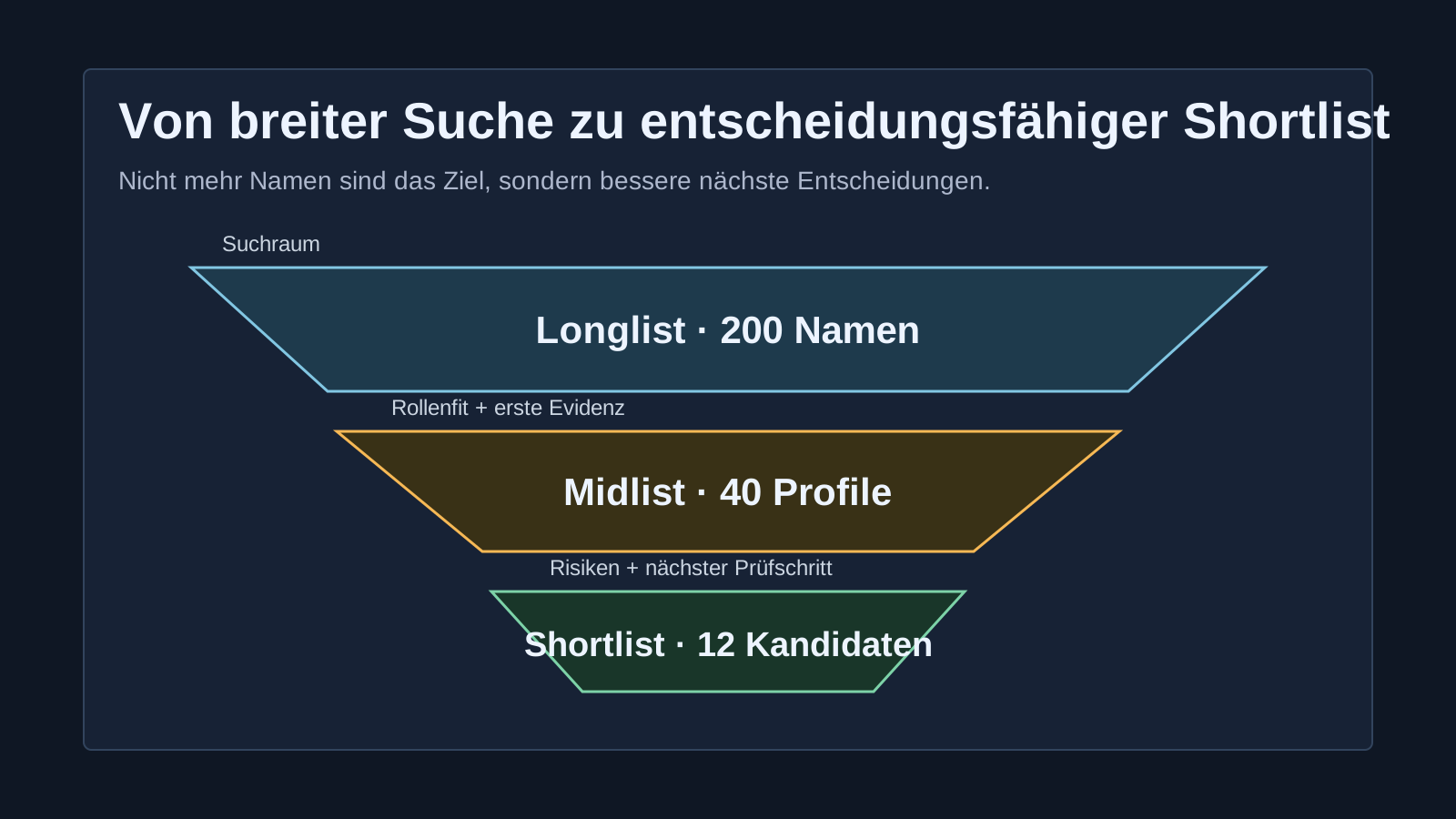

Step 1: Define the role precisely
The uncomfortable truth: every extra option costs attention.
And in a transfer window, attention is often scarcer than money.
The starting point is not position, but task.
Which role is missing in the squad?
Should the player start immediately or develop over time?
Does he need a specific pressing behaviour?
Is ball progression more important than box presence?
Those questions must be answered before the data filter.
Otherwise every later evaluation becomes unstable.
Step 2: Limit the search space deliberately
The search space strongly determines which names become visible.
League, age, contract situation, minutes base, nationality, budget frame and competition context should not be random.
A useful search space is narrow enough to be relevant and wide enough to allow surprises.
This is where data-aware systems create early value: they make transparent which candidates enter or leave the pool because of which assumption.

Step 3: Separate hard requirements
Not every preference is a must-have.
A club should separate:
- hard criteria without which the player does not fit
- strong positives that make the profile more attractive
- open questions that video or live scouting must answer
This prevents a player from disappearing too early because of one weak value, or rising too high because of one eye-catching strength.
Step 4: Explain the final shortlist
A decision-ready shortlist needs more than names.
It needs context:
- why the player is on the list
- which role he could fill
- which data supports that view
- which risks remain open
- which next scouting step makes sense
That makes the list usable for the board and the coaching staff.
A data collection becomes a decision proposal.

Conclusion
The best shortlist workflow is not the broadest possible filter.
It is a clean reduction process.
It starts with role requirements, uses data to prioritise and ends with clear next steps.
That way, 200 names become not just fewer names, but better decisions.
Why the first cut matters most
The first cut of a shortlist often determines the quality of the whole process.
If too many wrong candidates remain in the pool at the start, scouts and analysts spend days on players who were never realistic fits.
If the cut is too aggressive, interesting profiles disappear before they receive a proper football check.
The craft is therefore not finding twelve perfect names immediately.
The craft is reducing a broad list so that the remaining players deserve real decision work.
A good first cut separates obvious non-fits from open cases.
It should not over-interpret.
Age, minutes, budget range, rough position or role fit and availability are typical criteria.
This phase is about relevance, not final quality.
Anyone trying to identify the top three here is confusing screening with evaluation.
Search brief before search filter
Many clubs jump into filters too quickly.
Select league, set age, click position, sort a few metrics.
That creates results, but not necessarily the right ones.
The search brief has to come first.
A useful search brief answers at least five questions:
- Which role is missing in the squad?
- In which time frame should the player help?
- Which sporting must-haves are truly non-negotiable?
- Which financial limits exist?
- Which risks can be accepted consciously?
Only then should the filter be built.
The filter is no longer random.
It becomes a technical translation of the sporting task.
That is the difference between a database query and a scouting process.
The longlist needs labels
A longlist of 200 names is useful only if every name has a reason.
The reason does not need to be long, but it should be visible.
Examples: “high passing range”, “strong aerial duels”, “U23 with starter minutes”, “left foot and high-line profile”, “notable pressing volume”.
These labels prevent candidates from being discussed later from memory alone.
They make transparent why a player appeared in the first place.
This is especially useful when several scouts work in parallel or when the process runs across multiple weeks.
A good longlist is therefore not just a table.
It is a collection of hypotheses.
Each candidate receives a first working idea that will later be confirmed, sharpened or rejected.
From longlist signal to midlist
The second cut moves from longlist to midlist.
Two hundred names may become forty.
In this phase, hard data filters should be combined with a short video or profile check.
Sorting the numbers is often not enough.
One clip or a quick match-context check can show whether a value is realistic for the role.
The midlist should already contain categories:
- top fit for the target role
- interesting alternative type
- high potential with open risks
- financially attractive but sporting fit still open
- strong data with questionable context
These categories prevent all players from being judged by the same standard.
A young development player may carry different open questions than an immediate starter.
A low market cost may change the acceptable risk compared with an expensive transfer.

The shortlist needs decision readiness
A real shortlist is not only the best names from the midlist.
It is a set of candidates on which decisions can be made.
That means the most important questions should already be known for each player.
A decision-ready entry contains:
- role fit in one or two sentences
- key supporting data points
- notable video scenes or match examples
- context around league and minutes
- risks and counterarguments
- recommended next step
The next step can vary.
Sometimes it is a full video report.
Sometimes it is a live scouting visit.
Sometimes it is a conversation with the agent or environment.
Sometimes the right decision is to park the player because the data is interesting but the timing is wrong.
Why explainability saves money
Explainable shortlists save time and money.
When a club understands early why a candidate does not fit, it avoids expensive follow-up work.
When a candidate fits strongly, the club can move faster before the market becomes louder.
This matters especially in the summer window.
Many decisions happen under time pressure.
If the club only begins clarifying assumptions then, it loses speed.
A clean shortlist workflow ensures that the key arguments are already in place when the market moves.
Explainability also helps internally.
The coach, sporting director, board and scouting department rarely prioritise exactly the same things.
A good shortlist translates the scouting work so that all stakeholders discuss the same risks and opportunities.
Common shortlist mistakes
Three mistakes appear often.
First: broad lists without prioritisation.
They look diligent, but they only postpone the decision.
Second: favourite candidates too early.
Once a name is emotionally fixed, data is often used only for confirmation.
Third: missing negative logic.
Many processes explain why someone is interesting, but not what speaks against him.
A robust workflow protects against all three.
It forces prioritisation, keeps alternatives alive and makes counterarguments visible.
That is how better decision confidence is created.
What sporting directors gain
The value of a shortlist is not its length.
It is its decision quality.
Twelve well-explained candidates are stronger than 200 names nobody can properly interpret.
Strong shortlists come from clear role profiles, deliberate search spaces, clean reduction and honest risk work.
Clubs that master this process react faster, argue more clearly and increase the chance that the next signing is not only a good player, but the right player.
Timing and transfer windows
A shortlist workflow also has to think in time.
Not every good candidate is available at the right moment.
Some players are unrealistic in winter but open in summer.
Others are interesting only while their market remains quiet.
Others need another six months of monitoring because the data is promising but the role evidence is not stable yet.
Every shortlist should therefore include a timing column.
It says whether a candidate should be checked immediately, monitored medium-term or used only as a comparison profile.
This simple separation reduces operational stress.
When the transfer window becomes tight, the sporting leadership knows which names are actionable and which remain strategic observations.
Why rejections should be documented
Good shortlists do not store only positive decisions.
They also document why players were removed.
That sounds bureaucratic, but it saves work later.
If a name appears again in the next window, the club can quickly check whether the previous counterarguments have changed.
Maybe the minutes base was too small then, but is stable now.
Maybe the price was too high, but has normalised.
Maybe the role did not fit the previous coach, but fits the new game model.
Without documented rejection, the discussion starts from zero.
With clear reasoning, the organisation learns from every search.