Scouting · 9 min
Which 2. Bundesliga centre-back shows real Bundesliga signals?
A role-specific comparison of five centre-back profiles from the 2. Bundesliga 2025/26 and their possible Bundesliga signals.
FI-SO 360° Redaktion ·
Why the question is not “who is the best?”
Forget the ranking.
It is the wrong answer to the wrong question.
“Who is the best centre-back in the 2. Bundesliga?”
Wrong question.
The better question is harsher: who transfers?
That is not the same thing. Not close.
The best player in one league is often exactly that: the best player in that league. One level higher, he becomes ordinary.
Others look quiet until the context changes. Then everything fits.
Katić, Gruber, Lochoshvili, Pfeiffer, Müller.
Five profiles. Five signals. No crown.
The data does not tell you who wins. It tells you who is who.
That is worth more.
Why the best single number does not decide the case
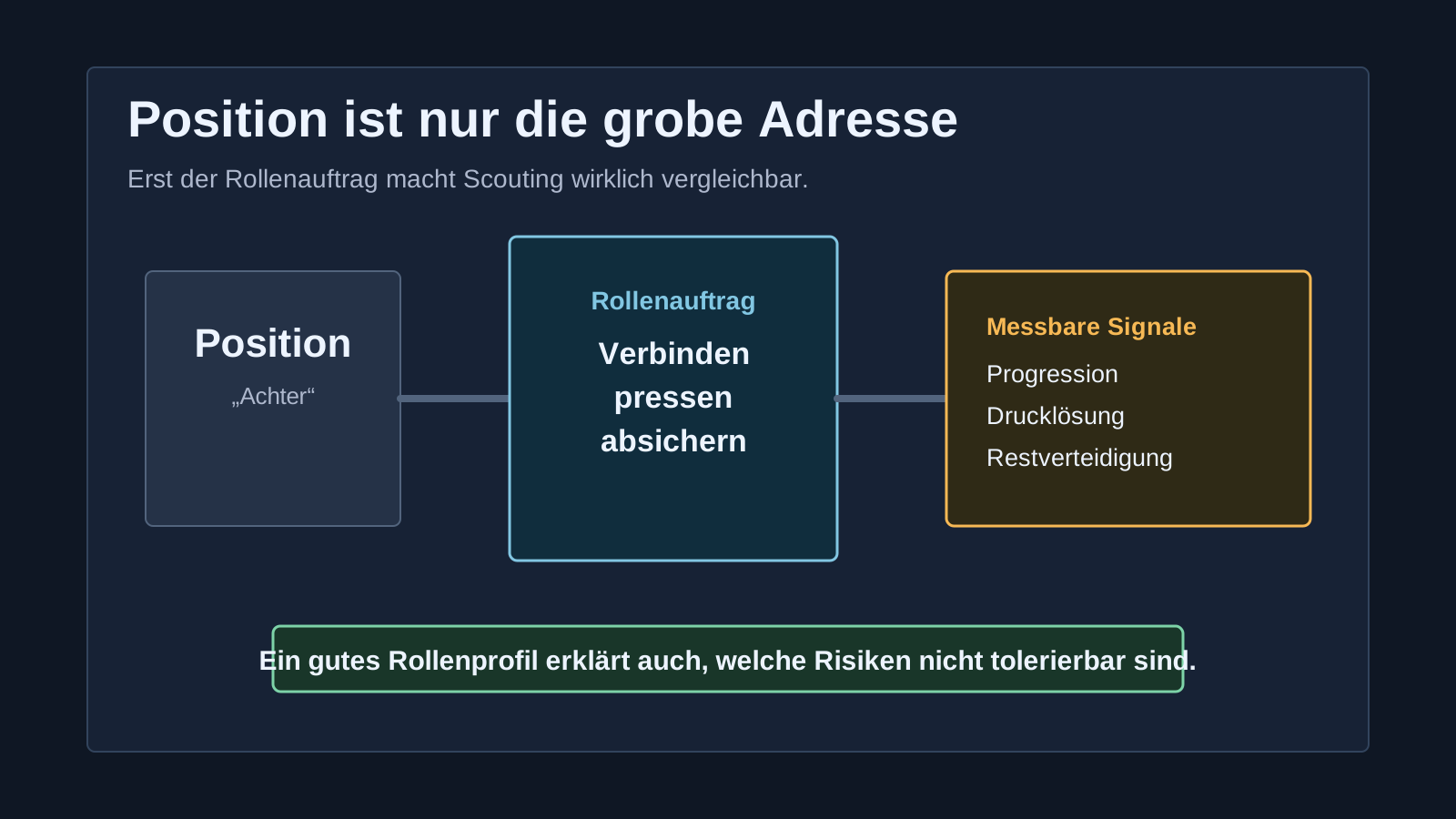
The uncomfortable truth is simple: profile beats placement.
The ranking asks for applause. Scouting asks for transferability.
A one-dimensional view can quickly mislead centre-back scouting.
A player with many clearances is not automatically better defensively than a player with a high pass completion rate.
A centre-back with strong aerial numbers is not automatically the better fit for a Bundesliga side than a cleaner build-up defender.
The more important question is: in which game model can this profile work, and in which model can it work especially well?
A team that defends deep, faces many crosses and has to survive direct phases needs a different centre-back profile than a team that holds a high line, wants clean possession and needs solutions under pressure.
That is why role profiles matter.
The five centre-backs as role profiles
The following profiles are not a simple ranking.
They show different routes towards relevance at a higher level: box protection, balance, defensive volume, passing range and build-up control.
1. Nikola Katić – the clear box-defender profile
Values:
- 191 aerial duels won
- 348 duels won
- 179 clearances
- 79.74% successful passes
- 42 accurate long balls
Nikola Katić is the clearest example of a classic box defender in this comparison.
His numbers point towards a profile built around physicality, aerial presence and direct defensive actions.
The combination of 191 aerial duels won, 348 duels won and 179 clearances makes his core strengths easy to read:
- penalty-area defending
- direct duel defending
- robustness in physical moments
- presence under pressure
In modern scouting, that profile can be very interesting, but not for every team in the same way.
Katić is not the prototype of an elegant build-up defender who controls attacks through the first third.
His 79.74% pass completion and 42 accurate long balls suggest that most of his value comes without the ball.
For Bundesliga teams looking for stability, box control and duel strength, this profile can be attractive.
That is especially true when the team does not need the centre-back to be its primary ball progressor.
Scouting conclusion: Katić sends Bundesliga signals through defensive sharpness and box defending, not through elegance in possession.
2. Fabio Gruber – the balanced overall profile
Values:
- 141 aerial duels won
- 327 duels won
- 86.41% pass completion
- 90 accurate long balls
- 181 clearances
Fabio Gruber looks like the most balanced centre-back in this group.
His profile is not defined only by physicality or only by build-up quality.
That mix makes him especially interesting from a scouting perspective.
With 141 aerial duels won and 327 duels won, he has clear defensive presence.
At the same time, 86.41% pass completion and 90 accurate long balls show that he does not drop off in possession.
His 181 clearances underline his activity and defensive load.
The strength of these profiles is often integration.
A coaching staff can usually work more flexibly with a balanced centre-back because he is not tied to one narrow specialist role.
He can satisfy several demands at a solid to good level.
That does not mean Gruber owns the best value in every category.
But in transfer and scouting processes, this type of player can be very valuable: few obvious weaknesses, good transferability and several possible use cases.
Scouting conclusion: Gruber looks like the most broadly usable profile in this comparison, which makes him a realistic candidate for the next step.
3. Luka Lochoshvili – high defensive volume with stable circulation
Values:
- 105 aerial duels won
- 355 duels won
- 88.05% pass completion
- 74 accurate long balls
- 180 clearances
Luka Lochoshvili stands out above all through volume.
His 355 duels won are a particularly striking number in this group.
Together with 180 clearances, they create the image of a defender who is constantly involved in defensive actions and solves many direct situations.
At the same time, his profile is not one-dimensional.
An 88.05% pass completion rate suggests that he remains stable in possession despite a high defensive workload.
He is therefore not just an emergency defender, but someone who can combine defensive output with clean circulation.
For scouts, that matters because these profiles often sit between two worlds:
- robust enough for intense duel phases
- clean enough for more controlled possession
The Bundesliga question is how well this defensive volume transfers to a higher tempo and larger spaces.
A high duel number is not automatically positive.
It can also reflect team context, playing style or structural pressure.
But when a player keeps pass quality stable at that volume, it is a strong signal.
Scouting conclusion: Lochoshvili offers a robust defensive profile with decent ball circulation.
He is interesting for teams that want stability without a clear loss in build-up quality.
4. Patric Pfeiffer – the standout range passer
Values:
- 101 aerial duels won
- 273 duels won
- 81.66% pass completion
- 158 accurate long balls
- 189 clearances
Patric Pfeiffer stands out through vertical range in his passing game.
158 accurate long balls are a very noticeable value and give his profile a clear direction: he can open the pitch, break lines and help teams that need more direct distribution.
That makes him especially interesting for teams that:
- want to gain space quickly
- need to release pressure from the first or second third
- use diagonal switches or vertical passes as a clear build-up tool
Defensively, he also provides substance.
101 aerial duels won, 273 duels won and 189 clearances show that he should not be read only as a passing centre-back.
Still, his most obvious signal is the ability to distribute over longer distances.
His 81.66% pass completion is not at the top of the group, but that is not surprising if the passing selection is more vertical or higher-risk.
In data-aware scouting, pass completion without pass profile is only partly useful.
A player who accepts more risk may create more valuable next actions, even if the raw completion rate is lower.
Scouting conclusion: Pfeiffer becomes especially interesting when a team needs a centre-back who does more than defend and actively brings range into build-up.
5. Tobias Müller – the clearest build-up profile
Values:
- 57 aerial duels won
- 157 duels won
- 94.51% pass completion
- 91 accurate long balls
- 94 clearances
Tobias Müller is the clearest build-up profile in this comparison.
His 94.51% pass completion is outstanding and points to a centre-back who supports possession phases with control, cleanliness and reliability.
In return, his physical defensive values are lower than those of the other profiles:
- 57 aerial duels won
- 157 duels won
- 94 clearances
That does not automatically mean he is weak defensively.
It shows that his profile is shaped differently.
Müller looks like a player whose value comes through clean first passes, control and circulation rather than maximum force in direct defensive duels.
For many Bundesliga teams, that can be highly relevant.
Teams that defend high, secure possession and want to play through pressure need centre-backs who do more than defend.
They need players who can structure the game.
However, team context is especially important for this type of profile.
A build-up centre-back often needs:
- suitable rest-defence structures
- good connection to the number six
- clear positional patterns in build-up
- protection against exposed one-v-one situations
Scouting conclusion: Müller sends Bundesliga signals above all as a clean build-up player with high passing security, especially for possession-oriented models.
What scouts and decision-makers should take away
The main lesson from this profile comparison is simple and central to squad planning: not every centre-back with Bundesliga potential looks the same.
These five players represent five different ways to become relevant at a higher level:
- Katić stands for box defending and aerial duels
- Gruber for the most balanced overall profile
- Lochoshvili for defensive volume and duel strength
- Pfeiffer for passing range
- Müller for build-up and game control
For scouting departments, that distinction is decisive.
Transfers often fail not because quality is missing, but because role fit is missing.
A very good centre-back can look worse in the wrong game model than a less spectacular player whose profile fits the team exactly.
The better question is therefore not: who is the best centre-back?
It is: which centre-back fits which game idea?
That is where the interesting scouting discussion begins.
The same logic applies to fit scores for transfer decisions: they should not replace scouting, but structure the first ranking.

Data is the starting point, not the final verdict
For scouts, sporting directors, coaches and analysts, the value of this type of comparison is speed and clarity.
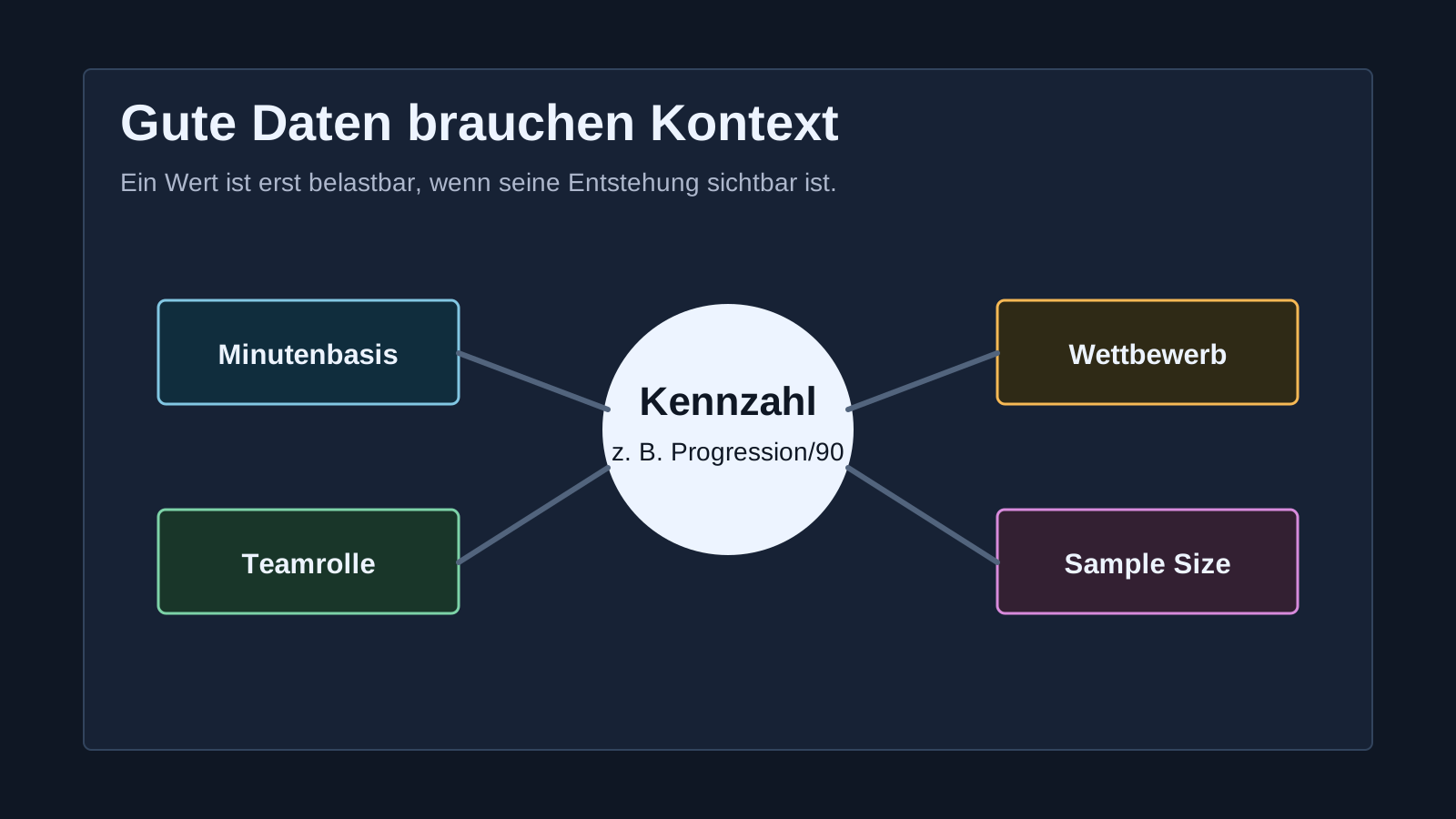
Numbers help identify patterns, classify player types and build sharper shortlists.
But they do not replace context work.
Final evaluation still needs questions such as:
- What do the actions look like on video?
- In which team context do the values emerge?
- How reliable is the profile at higher tempo?
- How does the player defend open spaces?
- How pressure-resistant is he really?
- What role does he take in possession phases?
- Does his profile fit the desired squad architecture?
This last point is essential for centre-backs.
A squad often needs complementarity rather than redundancy: the physical duel player next to the progressive build-up defender, the box defender next to the range passer.
Conclusion: Bundesliga signals can take different forms
The step from the 2.
Bundesliga to the Bundesliga is rarely only about individual quality.
It is mainly about transferability.
All five centre-backs send interesting signals in their own way, but not in the same way.
Anyone looking only for the most complete or best player risks missing the central point: profiles win games when they are placed in the right context.
That is why a data-aware, role-specific view of centre-backs is so useful.
The more interesting scouting question is not who looks strongest, but who creates the most value in which game idea.