Methodology · 8 min
Why role profiles tell scouts more than position labels
Position labels are a starting point. Scouting becomes valuable when requirements become measurable role profiles.
FI-SO 360° Redaktion ·

Position is only the rough address
Positions are comforting.
That is why they are dangerous.
“We need a left-back” sounds precise. It is not.
It is an address. Not a job.
A full-back can provide width. He can invert. He can cover. He can press. He can do all of it at an average level and still look useful.
The position label tells you where a player starts.
The role profile tells you what you want to pay him for.
That is the difference between scouting and collecting.
If you do not describe roles, you do not build a shortlist.
You build storage for names.
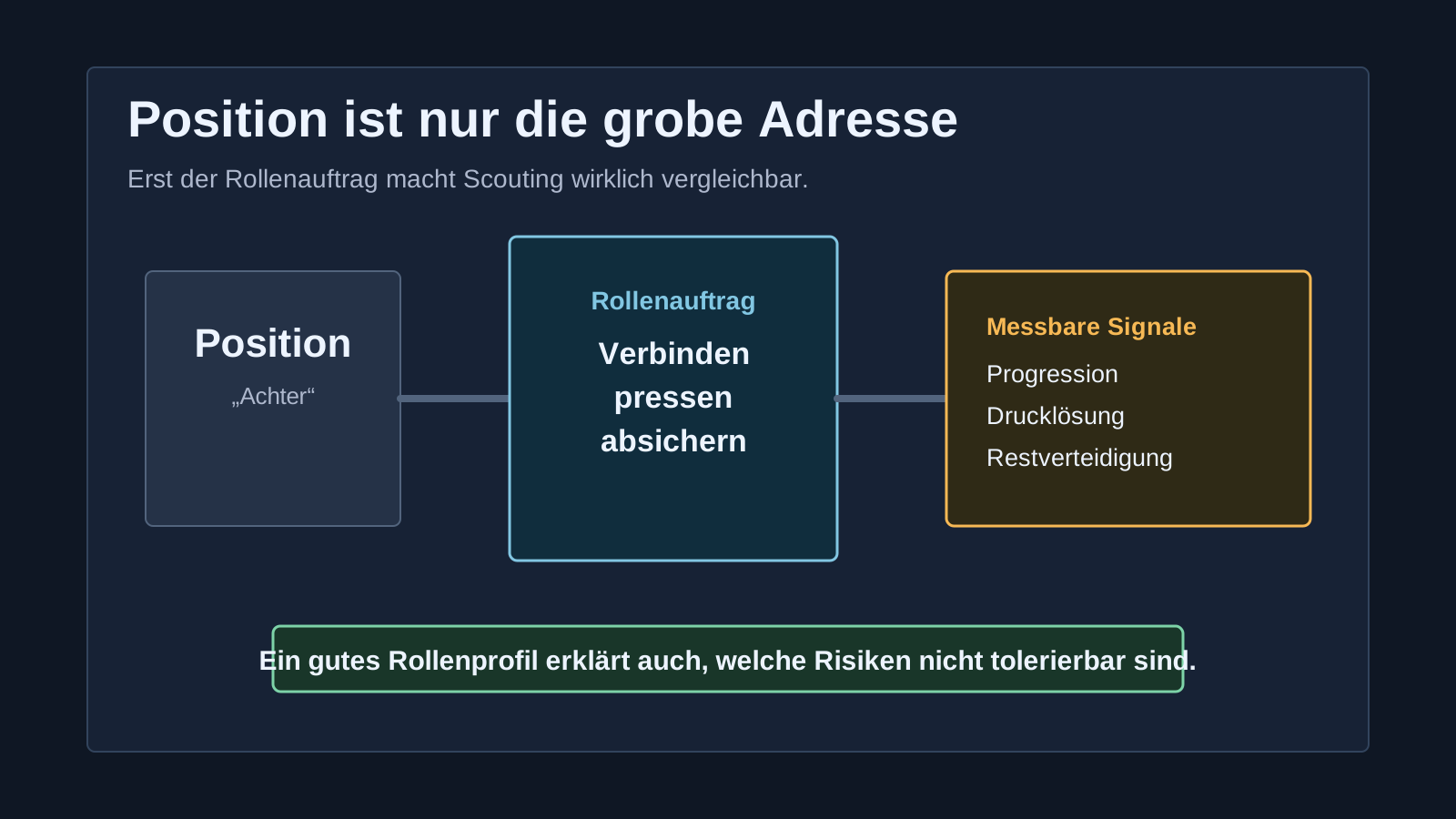
Strong role profiles connect three layers
The uncomfortable truth: a position rarely describes a decision.
If roles stay vague, candidates only roughly fit. Roughly is expensive.
A reliable role profile combines three perspectives:
- tactical task inside the club’s own game model
- measurable performance indicators from data and video
- context of the peer group, such as league, age, minutes and team role
Only that combination prevents single metrics from becoming too loud.
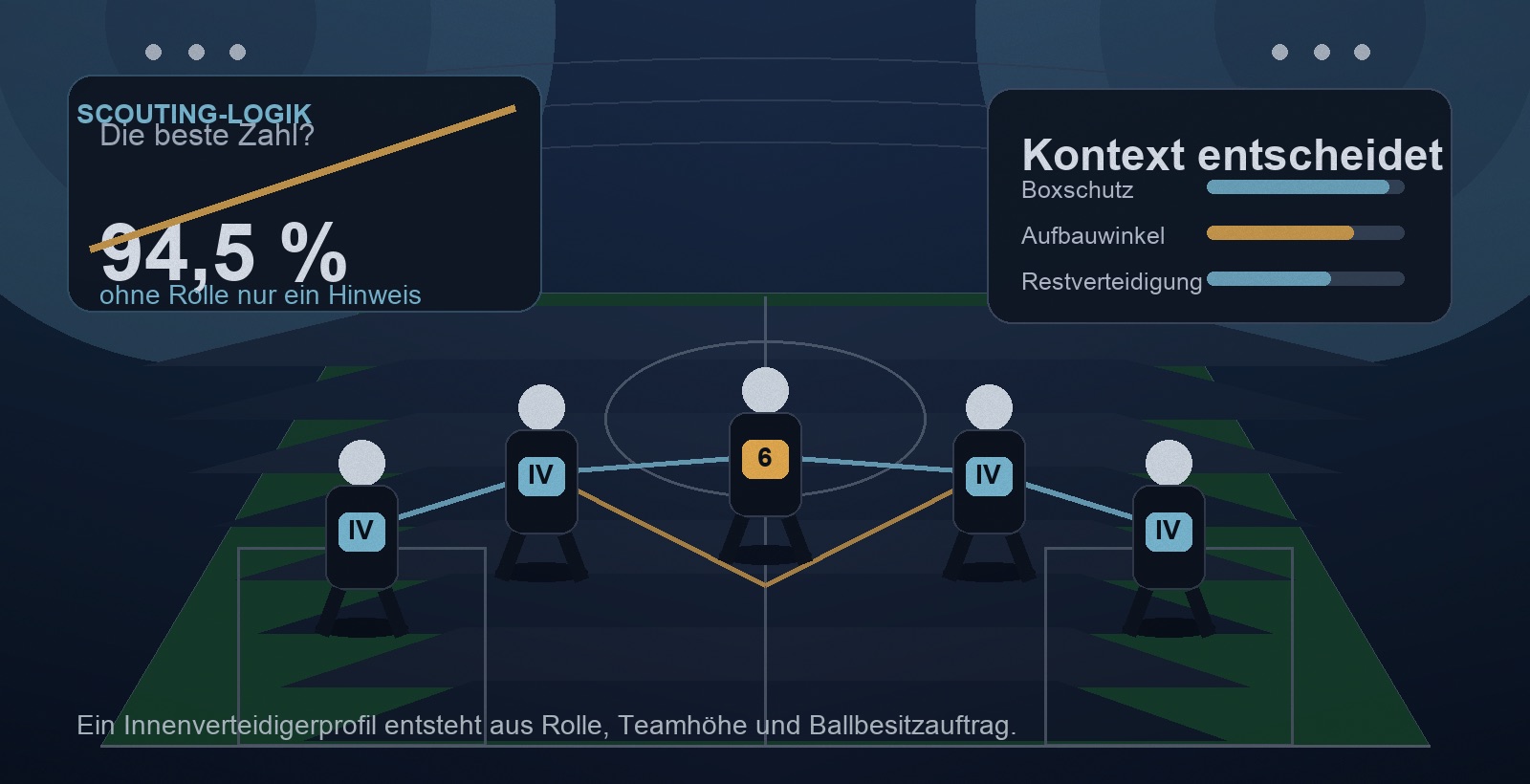
A high pass completion rate means something different if the player mostly plays safe passes.
Many defensive duels can show quality, but they can also suggest that his team is constantly under pressure.
Role profiles force scouts to interpret those signals.

From filter to decision
In practice, a role profile should not appear only at the end.
It belongs at the start of the scouting process.
Before a shortlist is built, the club should know which requirements really matter.
Example: a club is not simply looking for a “left-back”, but for a full-back who pushes high, combines flat in the final third and has enough recovery speed for rest-defence moments.
That produces different search signals than a deep defending team that mainly needs cross defence and direct duel strength.
Why this matters for lead decisions
Sporting directors and head scouts need to explain decisions.
Role profiles help turn a long list into a defensible shortlist.
They show not only who has good numbers, but why a player is interesting for a concrete role.
This is where a fit score becomes useful.
It should not be an abstract ranking, but a compression of the role profile.
The cleaner the role is defined, the better the club can explain why a candidate ranks high or why strong raw numbers are still not enough.
Conclusion
Position labels are useful for orientation, but too rough for serious transfer work.
Role profiles build the bridge between game idea, data and decision.
Clubs that define them well search less broadly, compare more fairly and can explain faster why a player really fits.
How a role profile is built in practice
A useful role profile starts with a sporting hypothesis.
The coaching staff describes which task is missing in the squad, and the scouting department translates that task into observable requirements.
That sounds simple, but it is often the hardest part of the process.
Many recruitment briefs start with a position because it is easy to say.
“We need a number eight” is convenient.
“We need a right-sided midfielder who can carry from deeper circulation, shift cleanly in a 4-4-2 pressing line and stay vertically connected after regains” is much more precise, but also much more demanding.
That precision is the point.
The clearer the task, the less the later data analysis has to guess.
A role profile should therefore begin in football language, not in numbers.
The sporting question comes before the metric.
Only after the relevant actions are clear should the analysts select the data points that can support the search.
A practical starting point is a shared role sheet with three areas: non-negotiable requirements, desired strengths and context-dependent bonuses.
A centre-back’s ability to defend open space can be non-negotiable.
Progressive passing range may be a desired strength.
Strong aerial dominance can be context-dependent if the team faces many crosses or wants a physical advantage on set pieces.
Metrics are weights, not truths
The most common mistake with role profiles is treating metrics as absolute too early.
A metric is not a verdict.
It is a signal.
It only gains meaning through weighting, peer group and context.
For a possession-oriented full-back, pass quality under pressure may matter more than raw crossing volume.
For a transition team, the same crossing volume may be more relevant if the player often attacks open spaces and reaches strong delivery zones.
That is why role profiles need weighting.
Not every metric has the same influence.
Some values are hard filters, others are explanatory signals.
A goalkeeper in a high defensive line needs a different out-of-box profile than a goalkeeper in a deep block.
Save percentage remains important, but it does not answer alone whether he fits the game idea.
Weightings also make discussions healthier.
If a scout rates a candidate highly but the role profile ranks him lower, one side is not automatically wrong.
The better question is: has the scout identified a quality that the profile does not capture yet?
Or is the player being overrated because his strengths are visible but secondary for the specific role?
Exclusion criteria should be explicit
Role profiles are often written too positively.
Clubs list what a player should do, but not which risks would make the deal problematic.
Serious recruitment needs both sides.
Exclusion criteria can be sporting: not enough speed for a high line, weak pressing intensity, poor scanning behind the body, unstable first touch under pressure.
They can also be contextual: limited minutes, unclear injury history, role proven only in a dominant team, or low evidence against higher tempo.
If those points appear late, the process wastes time.
If they are part of the role profile from the start, the shortlist becomes sharper.
That does not mean every candidate must be perfect.
It means known risks are discussed consciously.
A player may carry a risk, but the risk must be named and checked.

The value inside scouting meetings
The practical value of role profiles becomes clearest in meetings.
Without a role profile, scouts often discuss different qualities next to each other.
One person values technique, another physicality, a third the league, a fourth the price.
All of it matters, but nothing is ordered.
With a role profile, the discussion becomes more structured.
Every candidate is read against the same task.
Why does he fit?
Where does he not fit?
Which strengths really carry the case?
Which weaknesses are tolerable?
Which questions need video, live scouting or conversations?
This does not make decisions automatically easy.
But it makes them more explainable.
A sporting director can later explain why one player stayed on the list and another disappeared despite strong raw numbers.
That matters internally because transfer decisions rarely rest on one number.
They rest on confidence in the process.

Example: same position, different roles
Take two central midfielders.
Both are officially listed as number eights.
Player A is strong in link-up actions, moves cleverly between the lines and creates many progressive carries.
Player B is more stable defensively, wins second balls and protects the space next to the six.
A position filter treats them as similar candidates.
A role profile shows that they answer different questions.
If a team needs a connector against deep opponents, Player A may be more interesting.
If a team needs more control after losing the ball, Player B may be more valuable.
The point is not that one is better.
The point is that they serve different jobs.
That is why role profiles should not be seen as an academic exercise.
They prevent players with different tasks from being forced into one artificial ranking.
A ranking is fair only when the compared players are meant to solve the same role.
Role profiles must stay alive
A role profile should not be frozen after the first meeting.
Strong scouting processes learn.
If video analysis shows that a metric is overweighted, it should be adjusted.
If the coach changes the game model, the role must move with it.
If the market does not offer realistic candidates for the ideal version, the profile must be split again into must-have and nice-to-have requirements.
That is not weakness.
It is good process.
The market is never perfect.
Data is never complete.
Role profiles provide orientation, but they do not replace judgement.
They create a shared frame in which scouts, analysts, coaches and decision-makers can speak the same football language faster.
What clubs gain
Clubs that take role profiles seriously do not get a magic button.
They get a better decision frame.
Searches become clearer, shortlists become sharper and conversations about candidates become less arbitrary.
In professional football, where transfers are expensive, windows are short and internal views can differ, that clarity is a real competitive advantage.
The best question is therefore not: which players play this position?
It is: which players solve exactly our task?
Role profiles as a shared contract
Another benefit is often underestimated: role profiles act as a contract between coaching staff, scouting and sporting leadership.
They prevent each group from using its own definition of “fit”.
If the coach means a pressing-heavy number eight, the scout searches for a clean connector and the sporting director mainly sees resale value, friction appears.
The role profile forces these views together early.
This contract does not need to be bureaucratic.
One page with task, must-haves, weighted signals, risks and example players is often enough.
What matters is that everyone uses the same base.
Later disagreement becomes more productive: the discussion is no longer abstract taste, but whether the profile is still right or whether a candidate justifies a conscious exception.